

Root canal treatment in Vilnius
Cleaning and filling infected or damaged root canals in order to save the natural tooth (endodontics).
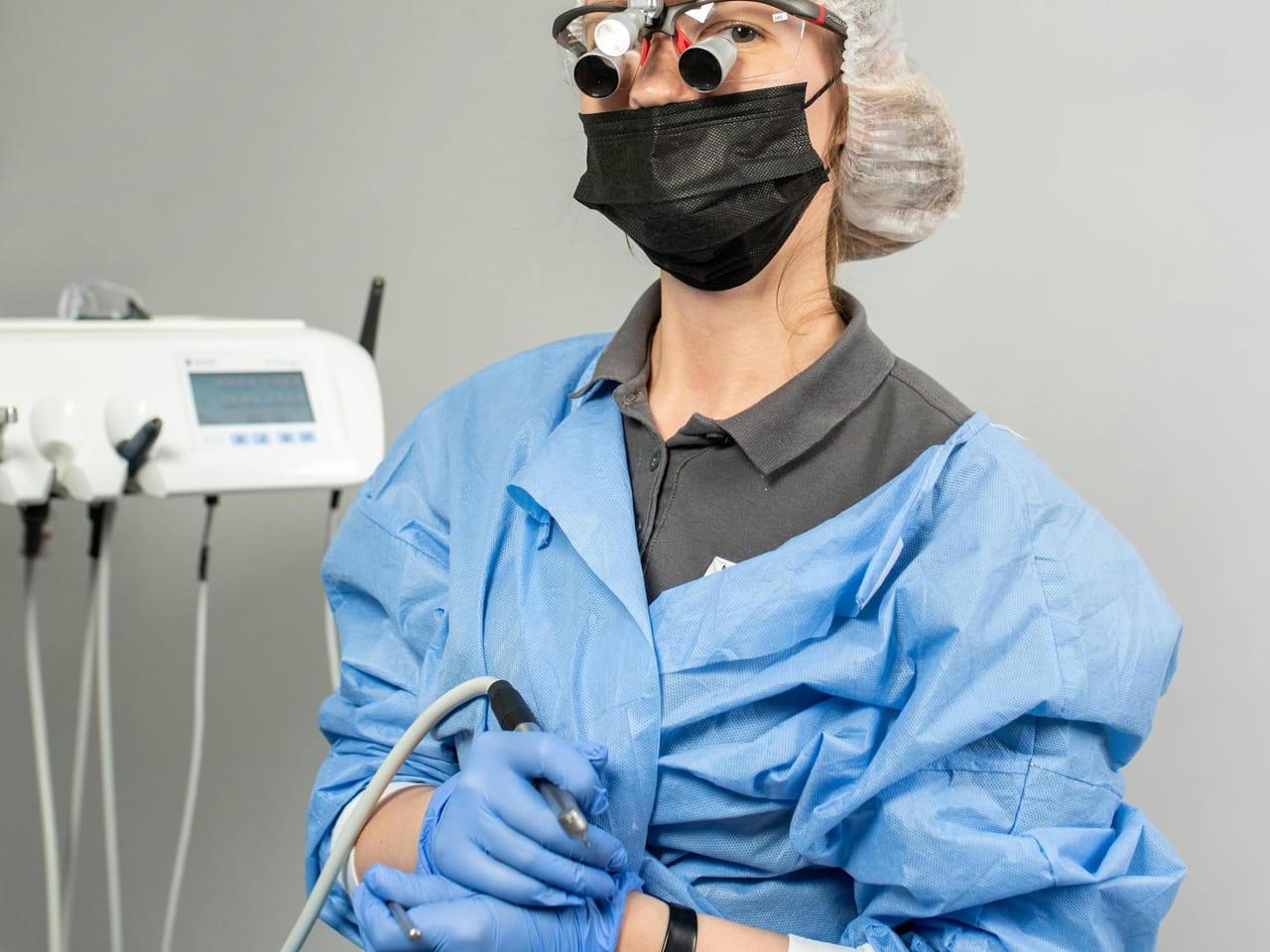
Treatment of root canals
When decay reaches the deepest layers of a tooth and damages the nerve inside, the usual result is a strong, throbbing pain. To save such a tooth and avoid extraction, root canal treatment is required. During the procedure the dentist removes the infected tissue from the root canals and seals them tightly.
Our specialists handle even very difficult canal cases. They regularly deal with severely curved or calcified canals and remove fractured instruments left behind by earlier treatment. In cases like these, modern equipment makes all the difference.
When is root canal treatment needed?
Inflammation inside a tooth does not always hurt constantly. See a dentist if you notice any of these signs:
- Strong, throbbing pain that wakes you at night or starts for no obvious reason.
- Sensitivity to hot or cold that lingers after the food or drink is gone.
- Pain when you bite or tap on the tooth.
- Swollen gum or a small abscess next to the tooth.
- A tooth that has darkened, often after an old injury.
- Inflammation at the root tip visible on an X-ray, even when the tooth does not hurt.
What makes our treatment different?
- 01
Working under a microscope
A dental microscope gives us a hugely magnified view inside the tooth. That lets us find even the finest root branches and avoid perforating the crown.
- 02
Retreatment of canals
We use up-to-date techniques to correct teeth that were poorly filled in the past, and we diagnose root fractures and internal resorption.
- 03
Warm gutta-percha system
Cleaned canals are filled with a heated material that adapts perfectly to the canal walls and blocks bacteria from returning.
How does root canal treatment go?
Depending on the number of canals and the inflammation, treatment takes one to three visits.
-
Diagnosis
We examine the tooth and take an X-ray. It shows how many roots there are, their shape and how far the inflammation has spread.
-
Anaesthetic and isolation
We numb the tooth and isolate it with a rubber dam, a thin rubber sheet that keeps saliva and bacteria out of the canals.
-
Cleaning the canals
We remove the damaged pulp, widen the canals mechanically and rinse them thoroughly with disinfecting solutions. In complex cases we work under a microscope.
-
Medication between visits
If the inflammation is severe, we place calcium hydroxide in the canals and seal the tooth temporarily so the infection can settle.
-
Filling the canals
The cleaned canals are sealed tightly with gutta-percha. A control X-ray confirms they are filled right to the root tip.
-
Restoring the tooth
Finally the tooth is restored with a filling. For back teeth we often recommend a crown after root canal treatment, as it protects the more brittle tooth from splitting.
Root canal treatment prices in Vilnius
The price depends on the number of canals: front teeth usually have one, molars three or four. Each canal is prepared and filled, while the anaesthetic, X-rays and final filling are charged separately. Re-treatment, when old filling material has to be removed, takes longer.
Prices are a guide. You get an exact estimate after the examination and, if needed, an X-ray.
Full price list- Mechanical and medicated preparation of one canal
- 60 €
- Filling one canal with gutta-percha
- 60 €
- Emergency endodontic care (devitalising agent applied)
- 65 €
- Calcium hydroxide (per canal)
- 10 €
- Use of a rubber dam
- 10 €
- Incision (draining an abscess)
- 40 €
- Local anaesthetic
- 10 €
- X-ray image
- 10 €
Frequently asked questions about root canal treatment
-
Is root canal treatment painful?
The tooth is numbed during the procedure, so it is no more painful than an ordinary filling. Often it is the inflammation itself that hurts, and treatment is what removes it.
-
How many visits will I need?
In simpler cases we clean and fill the canals in one visit. If the inflammation is severe, there are many canals or the tooth needs re-treatment, it usually takes two or three.
-
Can the tooth hurt after treatment?
The tooth may be tender when biting for a few days. That is a normal tissue reaction. If the pain gets worse, swelling appears or it lasts longer than a week, contact us.
-
Why treat the tooth instead of pulling it?
Your own tooth keeps the bone, your bite and your chewing intact. An extracted tooth later has to be replaced with an implant or a bridge, which costs considerably more than timely root canal treatment.
-
What is root canal re-treatment?
It is repeat treatment of canals that were treated before, when inflammation returns at the root. We remove the old filling material, clean the canals again and refill them. The microscope helps find missed canals and check whether the root is cracked.
-
What is the microscope for?
Magnification lets us see narrow and extra canals, calcified areas or a fragment of a broken instrument. This matters most for molars and re-treatment.
-
Will I need a crown afterwards?
Front teeth usually do well with a good filling. Molars become more brittle after root canal treatment, so when their walls are thin we recommend a crown or a ceramic inlay.
-
 Professional oral hygiene Effective removal of plaque and tartar, polishing, and advice on caring for your teeth day to day.
 -
 Aesthetic fillings Rebuilding damaged tooth tissue with modern, natural-looking fillings that restore both shape and function.
 -
 Oral surgery Complex extractions, cyst surgery, soft tissue corrections and other oral surgery procedures.
 -
 Dental implants Reliable, long-lasting replacement of missing teeth with titanium implants that act as artificial tooth roots.
 -
 Diagnostics and consultations Precise diagnostics using single-tooth and panoramic X-rays, which underpin the best possible treatment plan.
 -
 Periodontics Diagnosis and treatment of gum disease, helping to preserve the health of your teeth and mouth.
Take care of the whole
family's smile
From preventive hygiene through to implants and prosthetics, every dental service is in one place at Kalvarijų g. 103-17.